I bear witness to heart failure

Saniya Ahmed, M1, Class of 2027


Definitions for non-Muslim audiences: 

Shahada – the declaration of faith in the Islamic tradition, “I bear witness that there is no god but Allah, and I bear witness that Muhammad is His Messenger.” This is one of the five pillars of Islam. We recite this statement often but hope that it rolls off our tongues in our time of death so we may die with this declaration of faith.

Ummah – the global Muslim community, bound together by religion. Prophet Muhammad, peace and blessings be upon him, described the Ummah in this way: “The parable of the believers in their affection, mercy, and compassion for each other is that of a body. When any limb aches, the whole body reacts with sleeplessness and fever.” (Source: Sahih Al Bukhari 6011, Sahih Muslim 2586)

Author’s Note:

Saniya Ruqiah Ahmed began her poetry journey as a spoken word and slam poet in the realm of social justice advocacy. For nearly a decade, her art has been kept within the ears of her audience, and she is now aiming to bring her work to paper. Her poetry centers on themes like family, faith, social justice, and Muslim and Indian diaspora. Now as a medical student, her poetry has shifted to also encompass humanity and dignity in health and healthcare.

Diamonds in the Rough: Working as a Track Coach at an Inner-City High School while in Medical School

Diamonds in the Rough: Working as a Track Coach at an Inner-City High School while in Medical School

Liam Lynch, M2, Class of 2026

“Going to track practice every day was my escape from the monotony of medical school.
Going to track practice was their escape from things much worse.”

If you’ve met me, you know that running has been and will always be one of the most
pivotal parts of my life. It’s the reason I went to college, the reason for my drive and fortitude in
life, and an integral part of my daily routine. My yearly vacations center around where I’ll be
racing next and even my med school research revolves around running. In short, running is
intimate and intertwined with who I am.


Thus to me, nothing would be more worthwhile than giving back to the sport that has
gotten me to where I am today: Track & Field. We’ve all heard that volunteering in medical
school is one of the most crucial extracurriculars. Residencies will want to see a physician who
cares about their community and someone who gives without expecting anything in return. The
conclusion seemed natural; I was going to volunteer as an assistant track coach somewhere.


I reached out to many nearby Kansas City high schools: Shawnee Mission East, North,
and Bishop Meige. Bluntly put, these were the rich schools; they had the infrastructure and
funding to allow me to volunteer on a come-and-go basis. They didn’t need me at these rich
suburban schools but would take me and let me pad my resume.


Wyandotte was different though. Despite the strong, caring, and capable leaders I
encountered, decades of gentrification, rezoning, and defunding had led to its steady decline.
According to U.S. News & World Report, Wyandotte High School consistently ranks in the
bottom 20th percentile in all metrics for Kansas, ranking in the 2%, 3%, and 7% in math,
reading, and science proficiency, respectively. Freshmen make up 42% of their enrollment while
graduating seniors make up only 15%. The total minority enrollment is 98%, and 90% of
students are economically disadvantaged. Suffice to say, this school was very different from the
ones I grew up with and the other schools I was looking to volunteer at.


Wyandotte’s process was different, too. Head Coach Richie Bryant invited me for an
interview, which was something none of the other schools asked for. I figured that being an ex-
collegiate athlete turned medical student was qualification enough to volunteer—all the other
schools thought so too—but I agreed to an interview nonetheless. At the very least, it would
make my decision of where to volunteer easier.


I arrived at Wyandotte, passing the police officers and metal detectors stationed at the
entrance; it was already a stark difference from my own high school days. We went through
hallways displaying the trophies and banners of the school’s glory days that only those old
historic schools have. Then, after meeting Coach Keegan and Mr. Black, we sat down in the
bleachers of their basketball gym.

Continue reading “Diamonds in the Rough: Working as a Track Coach at an Inner-City High School while in Medical School”

Can A Fish Teach Medicine?

Adam Wilson, M1, Class of 2026

How can a fish teach medicine, how does diabetes result from environmental contamination, and how does environmental contamination cause illness through biological and non-biological mechanisms? I recently read “The River Is in Us: Fighting Toxics in a Mohawk Community” by Elizabeth Hoover, which prompted these questions. Hoover describes the impact of contamination and disruption of a Native American community’s environment located at Akwesasne along the St. Lawrence Seaway and bisected by the U.S.-Canada border. Akwesasne is downwind and downriver from a few sites, such as Reynolds Metals and General Motors Central Foundry, recognized as particularly hazardous to human and environmental health by federal and state governments. As a foreword, the Mohawk community at Akwesasne has a long history that this article cannot do justice to. I highly recommend reading Hoover’s book for more information on historical and cultural contexts.

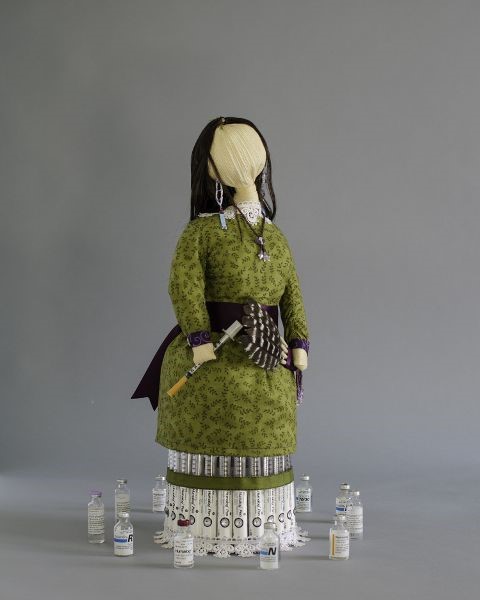
Sculpture by Akwesasne Mohawk artist Natasha Smoke Santiago, depicting a traditional Mohawk woman made from corn husks, insulin bottles, and hypodermic needles. This piece represents the rapid increase of cases of diabetes in the Akwesasne community, with the corn husks symbolizing the traditional foods that the artist wants her relatives to return to in order to regain their health. Photograph by Jessica Sargent. Caption by Elizabeth Hoover.
Continue reading “Can A Fish Teach Medicine?”

Luster

Luster

Maddy Mash, MD Class of 2025

Stress, anxiety, heavy feelings, whatever you want to call it, come with a potency that overwhelms our mind, influencing every decision and the way we perceive the world. 

I have noticed I tend to look back on challenging stretches of life and think, that wasn’t so bad. Time gives us a lens with the blurring stress filter removed, giving a romanticized picture of the seemingly lackluster moments you overlooked. When this appreciation comes, all those moments are far gone, wasted on a overextended and burnt out mind probably because something wasn’t working out exactly the way we wanted it to at the time. 

Continue reading “Luster”

RYR1

RYR1

Vincent Czerwinski, M3, Class of 2024

RYR1 encodes the ryanodine receptor—a calcium channel found in skeletal muscles which opens in response to sarcolemma depolarization allowing calcium to move from the sarcoplasmic reticulum into the cytoplasm. Those with RYR1 mutations experience central core disease—a congenital myopathy characterized by profound muscular flaccidity. To a young medical student, this phenomenon is ‘interesting,’ a label reserved for the few and far between cases in medicine when a clear cellular mechanism produced intuitive effects phenotypically. However, no amount of intellectualization can prepare medical students for the sight of a four-year-old intubated girl sitting completely still in her room—the only movement coming from her eyes as she tracks the new presence in her space. Students may find this sight so uncanny that they quickly scan the patient’s medications to check for paralytics, already forgetting what they’ve just looked up regarding the effects of RYR1 mutations. 

Students are encouraged to push this unease aside and proceed with their duties, checking with the mother for overnight updates and performing a physical exam. They diligently collect data points for the all-important presentation: one of the many metrics by which students are measured. 

Continue reading “RYR1”