Love your Patients

Simon Longhi, M3, Class of 2025

Love                       your Patients.

Her voice shakes
Gaze averts down, slowly,
hiding welled-up eyes.
But she takes a deep breath,
and states
for me:
“I feel like I’m falling apart inside… but, no.
They’re my kids, they’ve got their own lives,
… I can’t put that burden on them.”

I glance down, quickly,
at my quadrant-folded, wrinkled sheet of paper.
Lurching for an anchor– the right thing to say next,
from my scrawled, inadequate
pre-charting mess:
Myra M., 59yo lady, hx MDD moderate in remission, GAD
HR rep, three adult children, married 33 yrs
Lives w/husband (restaurant mgr, stopped working)–
recent frontotemporal dementia dx.

Myra was losing her husband, quickly.
She was becoming alone, slowly.
Her wrenching words,
yet suppressing outright despair.
Self-aware weakness,
yet wearing strength for others.
Devastating dichotomy.
I know this. Feel this.
My lips quiver, my own space behind the eyes
wells up,
because…
I saw my mom, in Myra.

My mom sacrificed everything,
for my sisters–
Autistic. Aggressive. Screaming.
Incontinent. Inconsolable. Seizures.
Innocent. Utterly un-independent.
Too much.
Worry constant, peace extinct.

The whole story feels untellable.
As a kid, processing this,
Puts the proverbial tip of the iceberg
To shame.

But Dad worked, paid the bills,
And really, I got to live free
without that wrenching responsibility.
Because, my mom insisted on it.
… Well, not in words, mostly unspoken
But I promise you, she lived it,
for me.
She may as well have said:
“Simon, I love you, do all that you ever want
with your life – Don’t worry about your sisters, please.
Keep going, don’t hold back, this is not your burden,
I got it. The world is yours, and this burden is mine.”

All of that past
is here now
in this clinic room.
In the span of a second or so, I feel everything
for this patient I just met.
I fold and re-fold the edges of my paper
Grip my pen more tightly,
as if it can absorb my nerves,
and contain a shudder in my chair.
Myra… mom… meaning.
Beautifully blurred lines in my mind.
I know where my compassion comes from,
and I’m proud of that.

But, I’m the healer now.
I have to be strong
this time– for my patient
For Myra.
FOCUS, on taking deeper history,
FOCUS, on forming treatment plan.
Love your patient, sure,
but don’t fall off that cliff of transference.
Yes, take in the view
That harrowing expanse.
But teeter well
on that cliff’s edge
Stay standing.
It’s your solemn duty.

Okay, deep breath–
next questions,
but still, keep listening.
Watery eyes are fine,
but no tears,
not right now.
Guide Myra on.
It’s my calling, my honor–
what my mom
Selflessly
imagined for me
all along.

I love                  you.

“Oh. Okay. ‘Burden’. Tell me more about that.”

I Don’t Have Time

I Don’t Have Time

Simon Longhi, M3, Class of 2025

I don’t have time.

I happened upon my two life roads
that diverged in a wood
so much later than I’d prefer.
It’s an echoey, reverberating–…
… –Err, berating, thing
that whirrs
like a sputtering motor
within my mind. Mulling
over so much, missed, in life.
I still want to reach, proverbial peace.
Keep, my sense of wonder.
Find, finally, someone to love.
But the wind that blows
down that sort of road,
could I even let,
that,
carry me?
Is that allowed?
Because to career, careen, down
–Medicine–, that path,
my calling, as a healer, now–
shouldn’t that demand in me, most everything?

I don’t have time.

Continue reading “I Don’t Have Time”

I bear witness to heart failure

Saniya Ahmed, M1, Class of 2027


Definitions for non-Muslim audiences: 

Shahada – the declaration of faith in the Islamic tradition, “I bear witness that there is no god but Allah, and I bear witness that Muhammad is His Messenger.” This is one of the five pillars of Islam. We recite this statement often but hope that it rolls off our tongues in our time of death so we may die with this declaration of faith.

Ummah – the global Muslim community, bound together by religion. Prophet Muhammad, peace and blessings be upon him, described the Ummah in this way: “The parable of the believers in their affection, mercy, and compassion for each other is that of a body. When any limb aches, the whole body reacts with sleeplessness and fever.” (Source: Sahih Al Bukhari 6011, Sahih Muslim 2586)

Author’s Note:

Saniya Ruqiah Ahmed began her poetry journey as a spoken word and slam poet in the realm of social justice advocacy. For nearly a decade, her art has been kept within the ears of her audience, and she is now aiming to bring her work to paper. Her poetry centers on themes like family, faith, social justice, and Muslim and Indian diaspora. Now as a medical student, her poetry has shifted to also encompass humanity and dignity in health and healthcare.

The Slide

Liam Lynch, MD Class of 2026

“I woke up after a nap one day with quite a bit of inspiration, so immediately I went to write this short story.”

“Welcome to Summer Camp,” the sign read. The excitement was palpable; the lot of us were all clamored together in that first courtyard. No one here had been to camp before, despite everyone being different ages. From the younger middle-schoolers, to the older of us high-schoolers, everyone was witness to the halcyon summer about to unfold. I knew going in that it was a goal of the summer camp to grow the older campers into leaders so that they’d come back the next year as counselors, and quite frankly, I was all-too-naïve and looking forward to the recognition and responsibility that would soon come with it. As we waited for the counselors to join us, I took in the moment.

Continue reading “The Slide”

Luster

Luster

Maddy Mash, MD Class of 2025

Stress, anxiety, heavy feelings, whatever you want to call it, come with a potency that overwhelms our mind, influencing every decision and the way we perceive the world. 

I have noticed I tend to look back on challenging stretches of life and think, that wasn’t so bad. Time gives us a lens with the blurring stress filter removed, giving a romanticized picture of the seemingly lackluster moments you overlooked. When this appreciation comes, all those moments are far gone, wasted on a overextended and burnt out mind probably because something wasn’t working out exactly the way we wanted it to at the time. 

Continue reading “Luster”

Can A Fish Teach Medicine?

Adam Wilson, M1, Class of 2026

How can a fish teach medicine, how does diabetes result from environmental contamination, and how does environmental contamination cause illness through biological and non-biological mechanisms? I recently read “The River Is in Us: Fighting Toxics in a Mohawk Community” by Elizabeth Hoover, which prompted these questions. Hoover describes the impact of contamination and disruption of a Native American community’s environment located at Akwesasne along the St. Lawrence Seaway and bisected by the U.S.-Canada border. Akwesasne is downwind and downriver from a few sites, such as Reynolds Metals and General Motors Central Foundry, recognized as particularly hazardous to human and environmental health by federal and state governments. As a foreword, the Mohawk community at Akwesasne has a long history that this article cannot do justice to. I highly recommend reading Hoover’s book for more information on historical and cultural contexts.

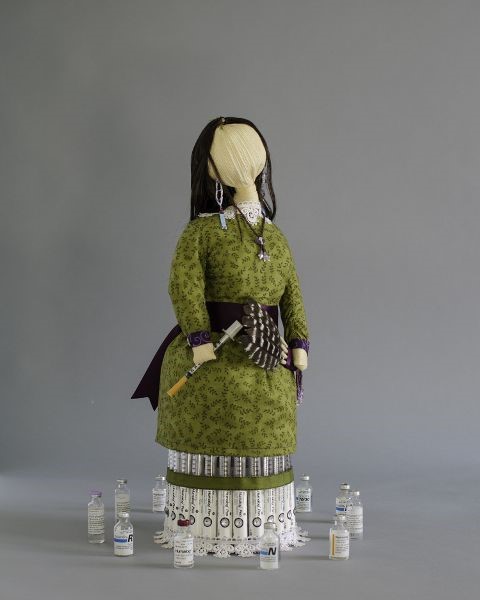
Sculpture by Akwesasne Mohawk artist Natasha Smoke Santiago, depicting a traditional Mohawk woman made from corn husks, insulin bottles, and hypodermic needles. This piece represents the rapid increase of cases of diabetes in the Akwesasne community, with the corn husks symbolizing the traditional foods that the artist wants her relatives to return to in order to regain their health. Photograph by Jessica Sargent. Caption by Elizabeth Hoover.
Continue reading “Can A Fish Teach Medicine?”