Soul Search – Finding Order in Chaos

Soul Search – Finding Order in Chaos

Mandeep Kaur, PhD Candidate in Biochemistry and Molecular Biology, 5th Year

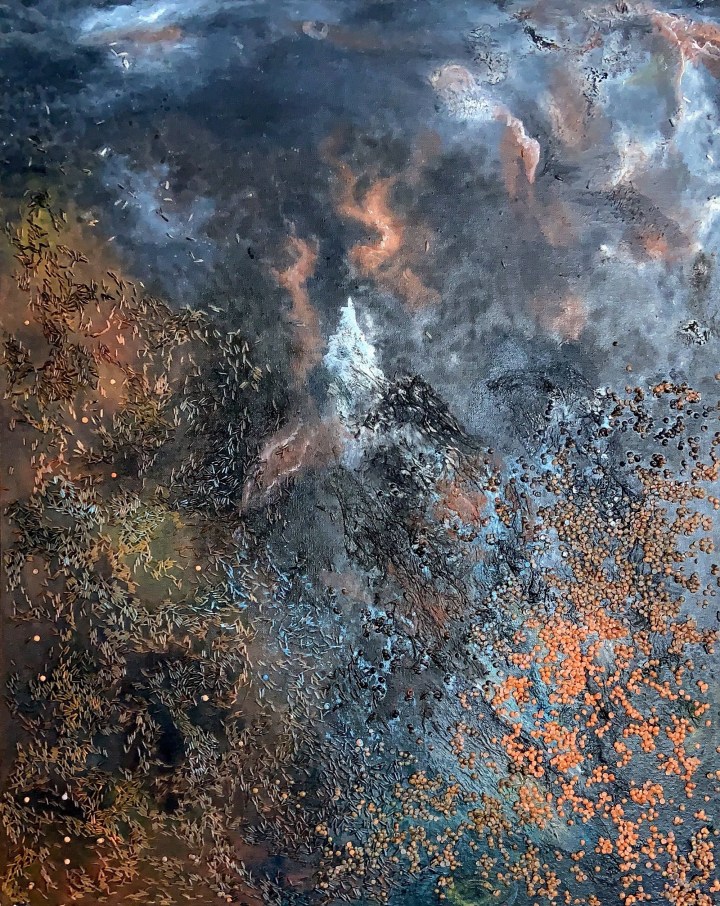
This piece of art is very close to my heart. I made it when I joined the graduate school. When everything seemed overwhelming including the classes, the lab research, being new to US and its culture, I painted all my mind out on canvas and I call it “Finding order in chaos”.

My Interventional Radiology Shadowing Experience

Samira Shorey, MD Class of 2026

“Honestly, it’s just a fun little blog post! I like keeping track of my experiences, perspective on medicine and specialties on my blog. I wanted to share it with others.”

This Monday, I jumped out of bed with unbridled excitement. I turned on some funky music and started getting ready to shadow an interventional radiologist.

Why was I so excited? Well, I had it in my mind that IR was the perfect specialty for me. It’s radiology + hands on procedures – two things I loved. You could not go wrong with that, I thought.

Continue reading “My Interventional Radiology Shadowing Experience”

A Little Death

Lindsey Glass, M.A. Speech Pathology, Class of 2024

I remember it clearly; the realization of what death was. Every living being dies. That meant the most important person in my life, my mom. I was around the age of four and realized my mom would die someday. The absolute disbelief and devastation. I threw myself on the kitchen floor, completely inconsolable. My mom comforted me. I do not remember what lead me to this realization, perhaps our pet hamster had recently passed. But my mom? She would die someday. This could not be. I refused to accept this fact. Eventually, after much of her kind and soothing words, she comforted me, and I moved on. This was part of life and I had to accept it. Now at the age of 32, honestly, I do not think I really accepted it, especially my mom dying someday.

Continue reading “A Little Death”

The Way We Remember

Cecile Hermanns, M1, MD Class of 2026

I met RM in September of last year. We were paired together as part of a yearlong program where medical students meet with dementia patients and learn from their experience. We ended up meeting in her kitchen on Saturday mornings, sitting at the kitchen table and drinking coffee.

RM has early-stage dementia. She was able to tell me about her life and remember details about mine. I received some phone calls about our plans – what cookies had we decided to bake? When was I out of town? – but overall, our conversations were like any others. Except I was surprised by the depth of familiarity we reached with one another in such a short time, the way she felt comfortable sharing anything and everything with me. As a medical student I could tell that I was perceived as someone confidential, a person to confide in and trust. 

Continue reading “The Way We Remember”

The Slide

Liam Lynch, MD Class of 2026

“I woke up after a nap one day with quite a bit of inspiration, so immediately I went to write this short story.”

“Welcome to Summer Camp,” the sign read. The excitement was palpable; the lot of us were all clamored together in that first courtyard. No one here had been to camp before, despite everyone being different ages. From the younger middle-schoolers, to the older of us high-schoolers, everyone was witness to the halcyon summer about to unfold. I knew going in that it was a goal of the summer camp to grow the older campers into leaders so that they’d come back the next year as counselors, and quite frankly, I was all-too-naïve and looking forward to the recognition and responsibility that would soon come with it. As we waited for the counselors to join us, I took in the moment.

Continue reading “The Slide”

Can A Fish Teach Medicine?

Adam Wilson, M1, Class of 2026

How can a fish teach medicine, how does diabetes result from environmental contamination, and how does environmental contamination cause illness through biological and non-biological mechanisms? I recently read “The River Is in Us: Fighting Toxics in a Mohawk Community” by Elizabeth Hoover, which prompted these questions. Hoover describes the impact of contamination and disruption of a Native American community’s environment located at Akwesasne along the St. Lawrence Seaway and bisected by the U.S.-Canada border. Akwesasne is downwind and downriver from a few sites, such as Reynolds Metals and General Motors Central Foundry, recognized as particularly hazardous to human and environmental health by federal and state governments. As a foreword, the Mohawk community at Akwesasne has a long history that this article cannot do justice to. I highly recommend reading Hoover’s book for more information on historical and cultural contexts.

Sculpture by Akwesasne Mohawk artist Natasha Smoke Santiago, depicting a traditional Mohawk woman made from corn husks, insulin bottles, and hypodermic needles. This piece represents the rapid increase of cases of diabetes in the Akwesasne community, with the corn husks symbolizing the traditional foods that the artist wants her relatives to return to in order to regain their health. Photograph by Jessica Sargent. Caption by Elizabeth Hoover.
Continue reading “Can A Fish Teach Medicine?”

Community: then, now, and there

Emily Casteen, MD Class of 2026

As a Narrative Editor of Med Intima, I have the privilege of sharing the experiences and stories of members of the KUMC community. I’m so grateful for my classmates in Group 23 who sat down with me to reflect on their own journeys finding community during M1 year. Their vulnerability and courage are an inspiration to me! Above all, this piece seeks to remind us that we are not alone. 

Continue reading “Community: then, now, and there”